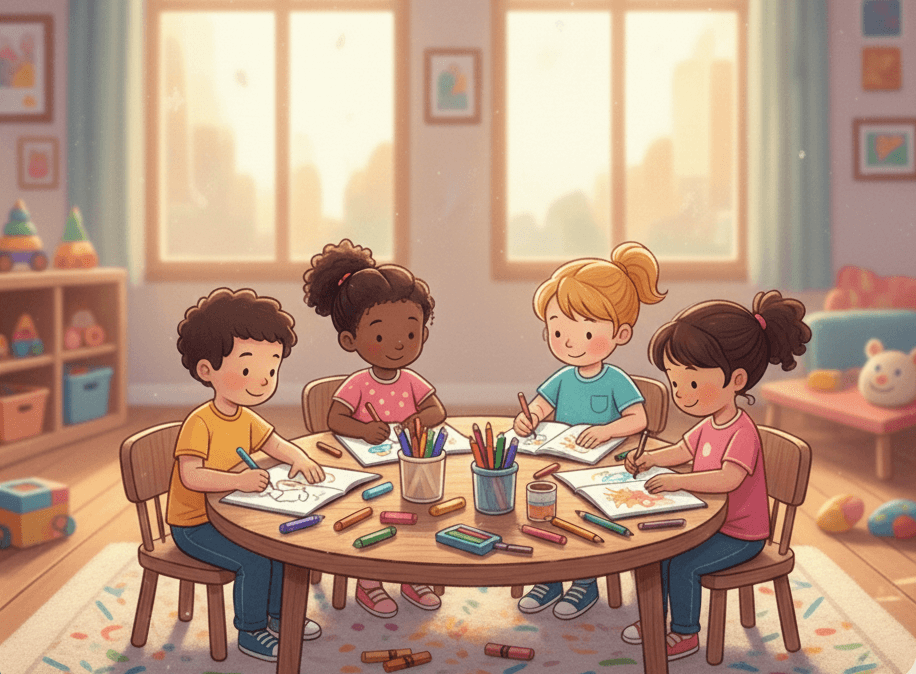
In today’s digital age, offering children creative outlets like coloring pages or kids coloring book formats is more than just fun. Science shows that simple activities like coloring and drawing play a crucial role in foundational early childhood development. Below, we explore the main benefits, supported by recent research.
🧠 1. Boosting Fine Motor Skills & Hand–Eye Coordination
One of the most immediate and tangible benefits of coloring is the significant improvement of fine motor skills. When children hold crayons, markers, or pencils to fill in coloring book pages, they exercise the small hand and finger muscles, leading to improved coordination and control.
A 2024 study at Kindergarten Dharma Wanita (ages 4–6) found that after regular coloring sessions, 75.9% of children showed development in fine motor skills appropriate for their age — a sharp increase from 37.9% before the intervention.
Similarly, research in early childhood settings observed that coloring significantly improves motor control, which directly supports other complex tasks like writing later on. This coordination training is fundamental — using a coloring book for kids (or printable coloring pages) helps prepare children for essential school-related tasks like legible writing and using scissors.
💡 2. Enhancing Creativity and Imagination
Coloring is not merely about staying strictly within the lines; it is a fundamental form of self-expression and creativity. When kids choose colors, decide where to shade, or even add extra drawings and details, they actively engage in imaginative thinking and problem-solving.
A 2023 study on preschoolers (ages 4–5) found that after implementing drawing and coloring “play therapy,” 93.8% of children scored in the “high creativity” category — a dramatic increase from the initial 18.8%.
Another study with children aged 5–6 showed a consistent increase in creativity scores across multiple cycles of coloring activity. Thus, whether via a cozy kids coloring book, a printable coloring book, or a simple sheet of coloring pages, coloring offers a low-cost yet powerful way to nurture and express creative thinking.
🧠 3. Supporting Cognitive Development & Focus
Coloring and drawing are not merely artistic; they directly tap into cognitive functions and concentration. Engaging in coloring requires children to pay attention to boundaries, select appropriate colors based on memory, and coordinate hand-eye movements simultaneously — all crucial skills for academic learning.
In one study, coloring as part of early childhood education stimulated cognitive aspects such as object recognition (names, functions), color identification, logical thinking, and basic concept understanding. Experts argue that art-based activities like coloring help children process information visually, support symbolic thinking, and facilitate better memory and observation skills.
Moreover, the focused, repetitive nature of filling in areas encourages patience, sustained attention, and concentration, which directly carries over to academic learning contexts.
❤️ 4. Emotional Expression, Self-Confidence & Well-Being
Coloring and drawing offer safe, nonverbal ways for children to express feelings, ideas, and experiences. This is especially helpful for children who may struggle with verbalizing complex emotions.
Research in art education emphasizes that drawing and coloring offer children a medium to express emotions, tell stories, and process difficult experiences — significantly contributing to their emotional and social development. For many children, especially those with special needs, coloring becomes a unique and accessible channel for self-expression and emotional growth.
This emotional outlet — combined with the creative satisfaction of completing a picture — fosters self-esteem and a strong sense of accomplishment (“Look what I made!”), which is invaluable for a child’s overall psychological health.
🧩 5. A Versatile Medium: From Paper to Digital
One of the greatest strengths of coloring is its flexibility and accessibility. All formats—whether a physical kids coloring book, printable coloring pages, or digital coloring book apps—can yield the significant developmental benefits described above.
For parents and educators, this versatility means coloring can be easily adapted to different situations: at home, in class, during travel, or even as a calm-down activity. As long as the activity involves engaging images and space for personal expression, the core developmental benefits remain consistent.